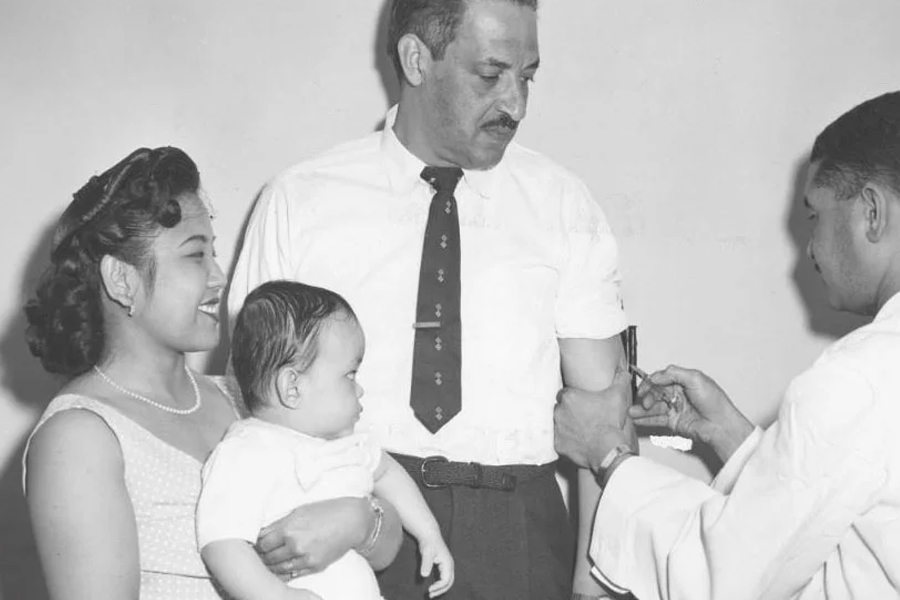
Basic Information
| Field | Detail |
|---|---|
| Name | Vivian Burey Marshall |
| Nickname | “Buster” (used by family and close friends) |
| Born | February 11, 1911 |
| Died | February 11, 1955 (age 44) |
| Marriage | Married Thurgood Marshall — September 4, 1929 |
| Children | None (records and biographies indicate miscarriages and no surviving children) |
| Occupation | Secretary / Administrator; worked with NAACP/Legal Defense Fund circles |
| Notable associations | Thurgood Marshall (husband), NAACP, NAACP Legal Defense Fund, later commemorated by educational programs bearing her name |
I want to start this like a film — a slow dissolve from the streetlights of 1920s Baltimore into a cramped, cigarette-smoked office where history is being written in pencil and quiet courage. That’s how Vivian Burey Marshall enters my imagination: not as a headline but as the frame around the photograph — essential, steady, often overlooked. I’ve always been drawn to the people who keep the cameras running; Vivian was one of those people. She was the spouse who turned the house into a home strong enough for a future justice to carry the world.
Early life and family — names, faces, and the Philadelphia kitchen table
Vivian was born on February 11, 1911 and raised in Philadelphia in a household where work and family braided together. Her father, Christopher Hamilton Burey, and her mother, often listed as Maud (Maude) Burey, worked in catering — which to me reads like a neat metaphor: a family that fed people for a living, and later fed the courage of a movement by keeping its people nourished in the small ways. Family records show siblings — names like Evelyn, Irene (Christine), and Christopher Jr. — the sort of roster that reads like a neighborhood baseball team, loud and loyal.
If you imagine a table to sort those relationships, it looks like this:
| Relation | Name | Role/Note |
|---|---|---|
| Father | Christopher H. Burey | Worked in catering; Jamaican connection in family records |
| Mother | Maud (Maude) Burey | Worked in catering; homemaker |
| Siblings | Evelyn, Irene (Christine), Christopher Jr. | Listed in genealogical records |
| Husband | Thurgood Marshall | Married 1929; future NAACP chief counsel and U.S. Supreme Court Justice |
This family constellation matters because Vivian was not an island: she carried a number of intimate loyalties and histories into a marriage that would place her at the center of civil-rights legal strategy.
Marriage, partnership, and the invisible labor of change
On September 4, 1929, Vivian married Thurgood Marshall. That day — eight days after the stock market crash that heralded the Depression-era century — their marriage began against a backdrop of economic and social turbulence. I like to think of June 1954 — the Brown decision — as the climax of a noir film, with Thurgood on the courthouse steps and Vivian somewhere behind the curtains, tending the wick of normal life. She worked as a secretary and administrator, a role that, in a literal sense, kept the files, correspondence, and day-to-day logistics moving for the people who would change law.
There were no headline-making salaries attached to her name; the currency she traded in was steadiness. The couple had no surviving children; sources indicate miscarriages. Those losses, quiet and private, sit like unspoken scenes in a script: the personal sacrifices threaded through the public triumphs.
Career and public life — practical, present, indispensable
Vivian’s professional life was modest in public record but immense in practical impact. As a secretary/administrator in the circles where the NAACP and the Legal Defense Fund operated, she handled the nuts-and-bolts that make legal activism work: letters, appointments, lodging, household order. If Thurgood was the lead actor, Vivian was the stage manager who kept the set from collapsing. She spent time in Baltimore and later in New York, wherever the legal fight demanded presence and the home base needed tending.
Think of her career as the scaffolding of a skyscraper — unseen in photographs but absolutely necessary for the architect’s vision to reach the clouds.
Illness, timing, and the human cost of historic moments
Vivian’s life ended on February 11, 1955, her forty-fourth birthday — a detail that reads like a bruised, poetic final shot. She died of lung cancer after a period of illness during which she attempted to shield her husband. One of the most wrenching historical ironies: while Thurgood argued and argued and argued — including in the seismic Brown v. Board of Education decision in 1954 — Vivian was ill at home. The timing makes the story cinematic and sorrowful; it also underlines the private costs of public battles.
Dates to keep near your eye:
- 1929 — Marriage to Thurgood Marshall (September 4).
- 1954 — Brown v. Board decision argued and decided.
- 1955 — Vivian’s death (February 11).
Cultural afterlife — a name that reappears
Vivian’s name has been reclaimed in the decades since by educational initiatives and by portrayals in popular culture. She appears as a presence in portrayals of Thurgood’s life, notably dramatized in film and commemorated via educational programs that borrow her name for academies and STEM initiatives — a fitting echo: a woman who ran practical affairs now lends her name to programs that aim to build practical futures for young people.
The domestic choreography — small facts, big rhythms
If you want specifics, here they are in a tidy list — the little facts that make a life readable:
- Married at age 18 (1929).
- Died aged 44 on her birthday (1955).
- Occupation: secretary/administrator in NAACP-related circles.
- No surviving children; miscarriages reported in contemporary biographies.
- Parents: Christopher H. Burey and Maud (Maude) Burey; siblings include Evelyn, Irene, Christopher Jr.
I say these like a director listing props: necessary, chosen, evocative.
FAQ
Who was Vivian Burey Marshall?
Vivian Burey Marshall was the first wife of Thurgood Marshall, a secretary and administrator who worked in NAACP/LDF circles and supported her husband’s legal career while managing the household and its many demands.
When was she born and when did she die?
She was born on February 11, 1911, and died on February 11, 1955, passing away at age 44 on her birthday.
Did Vivian and Thurgood Marshall have children?
No, they did not have surviving children; contemporary accounts and biographies indicate that she suffered miscarriages.
What was her occupation?
She worked as a secretary and administrator, assisting with the day-to-day work and correspondence tied to civil-rights legal work and the NAACP milieu.
What is her legacy today?
Her name has been used for educational initiatives and appears in cultural portrayals, keeping her memory tied to the movement her husband helped lead and to community education efforts.
How did her illness intersect with Thurgood Marshall’s career?
She became ill with lung cancer during the early 1950s and died shortly after the 1954 Brown v. Board victory, a quiet personal tragedy unfolding while the public legal victory reverberated.
How Cutting Edge Dental Technology Is Transforming Patient Care
How Preventive Plumbing Repair Services Reduce Common Household Plumbing Issues
Why Two Bedroom Townhomes For Rent Is An Ideal Option For First Time Renters


